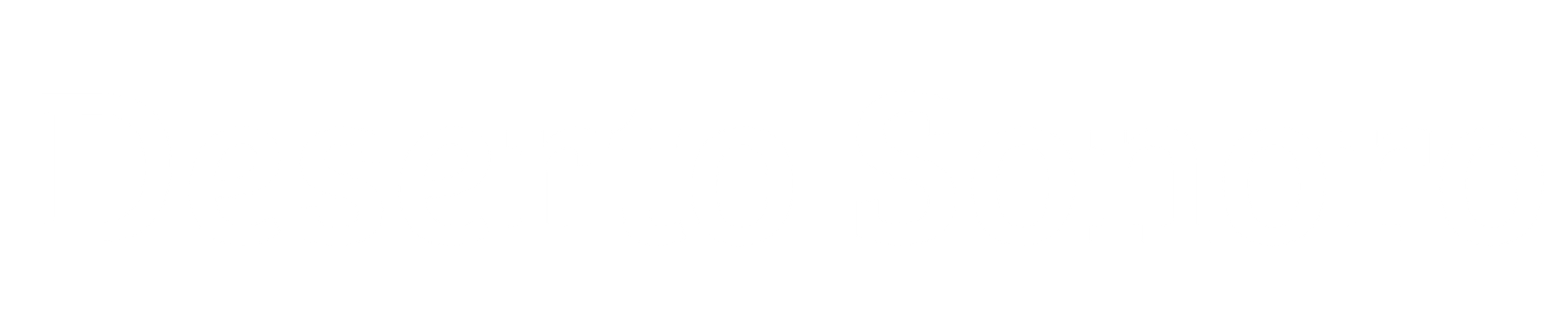
The Architectures of Dream by Valeria Pazos

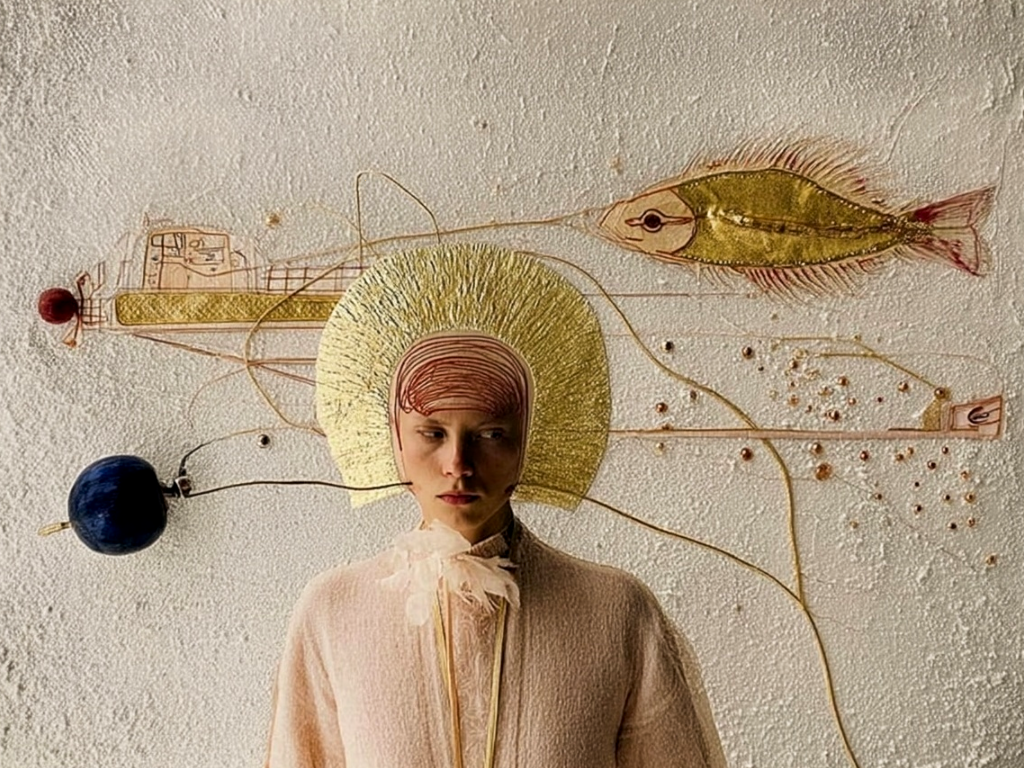
María Valeria Pazos studied at the Faculty of Philosophy at the National Autonomous University of Mexico (UNAM)in Mexico City, where she began a line of research that intertwines theory, the body, and perception, exploring imagination as a sensory experience. Her work moves across disciplines, drawing from theater, poetry, and performative practices. Raised in an environment steeped in magical realism, popular symbolism, and the surrealist traditions of Latin American culture, Valeria brings to her visual language a natural continuity between myth and everyday life. In recent years, she has developed an original dialogue with artificial intelligence, which she does not regard as a tool but as a living environment for imaginative co-creation. Her works generate dreamlike landscapes in which the boundary between dreams, memory, and digital imagery becomes increasingly porous. In this process, images are never static: they emerge, transform, and sometimes even enter the artist’s own dreams. At the same time, she directs a sensory theater company and develops collective practices dedicated to shared imagination. This interview offers a glimpse into her suspended universe, where AI does not replace the human being, but compels us to learn how to dream again.
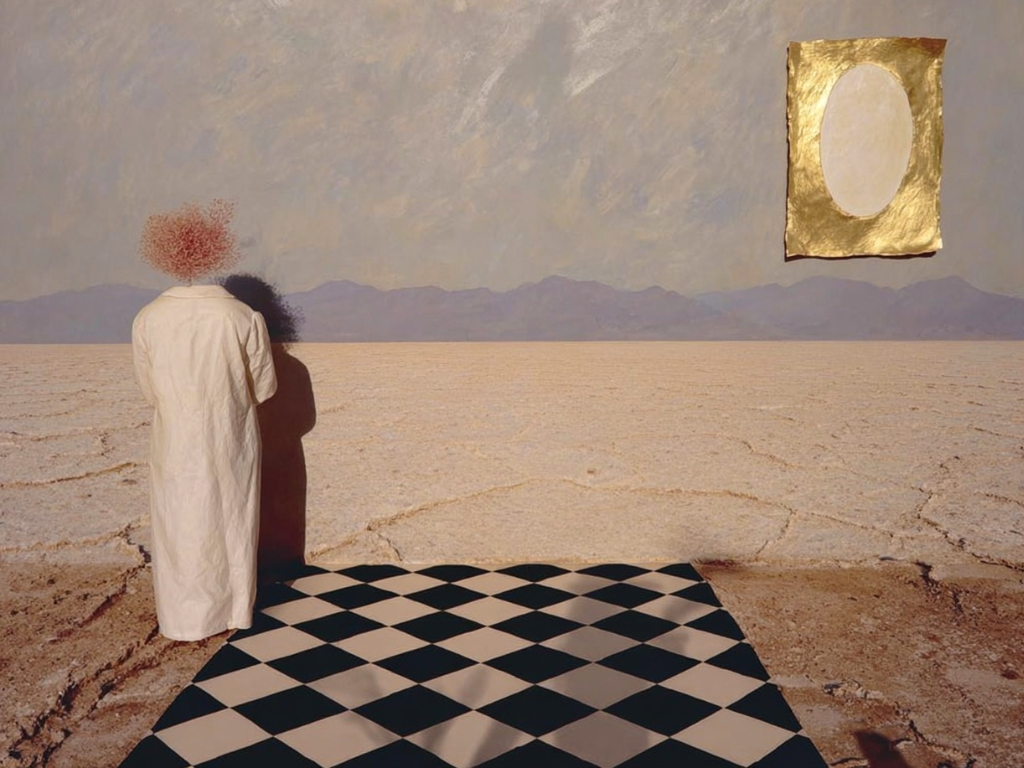
In your works, dreams seem to hold the same status as memory or reality. For you, is dreaming a way of escaping reality, or a deeper way of inhabiting it?
We live inside an imaginary; we inhabit an imaginary constantly. There is a close link between the political and the creation of atmospheres designed to produce certain states, emotions, or ways of life — think of cities and architectures designed to prevent people from gathering, from coming together. It feels urgent to me to recognize these atmospheres, how they operate, and how we might propose other ways of inhabiting the world. Dreams allow us to escape these realities, like Plato’s cave. It isn’t that every imaginative atmosphere is bad in itself; it’s that, while we are immersed in one, it becomes harder to recognize it and to remain critical. Dreams are precisely part of this resistance, a zone where it is possible to operate with another logic, to propose new forms of life. The status of dreams belongs to the realm of the imaginary, and so they are a way of escaping certain atmospheres that may be constraining how we live with others toward more sensitive ways of being. There are realities we need to escape, and the dream lets us reconnect with that sense of agency, with the possibility of building other worlds, with the capacity to create new forms of life. In dreams reality becomes more malleable, more plastic, and so returning to them in waking life becomes a way of making ourselves more aware of this freedom that lies in imagining and creating. To explore dreams is to exercise our capacity to escape from realities that are harmful.
Fish, water, rooms, and thresholds recur throughout your work. Is there a symbol that you keep encountering without yet fully understanding it?
The circus and masks are symbols that appear recurrently. I think I’m not fully aware of why. I believe I identify with those who stand at the periphery, and the circus is a ritual space where all the rules are transformed. There, reality is suspended for a while, and we enter another imaginary. Sometimes the meaning of a symbol arrives long after using it. But there is something in them that draws us like magnets.
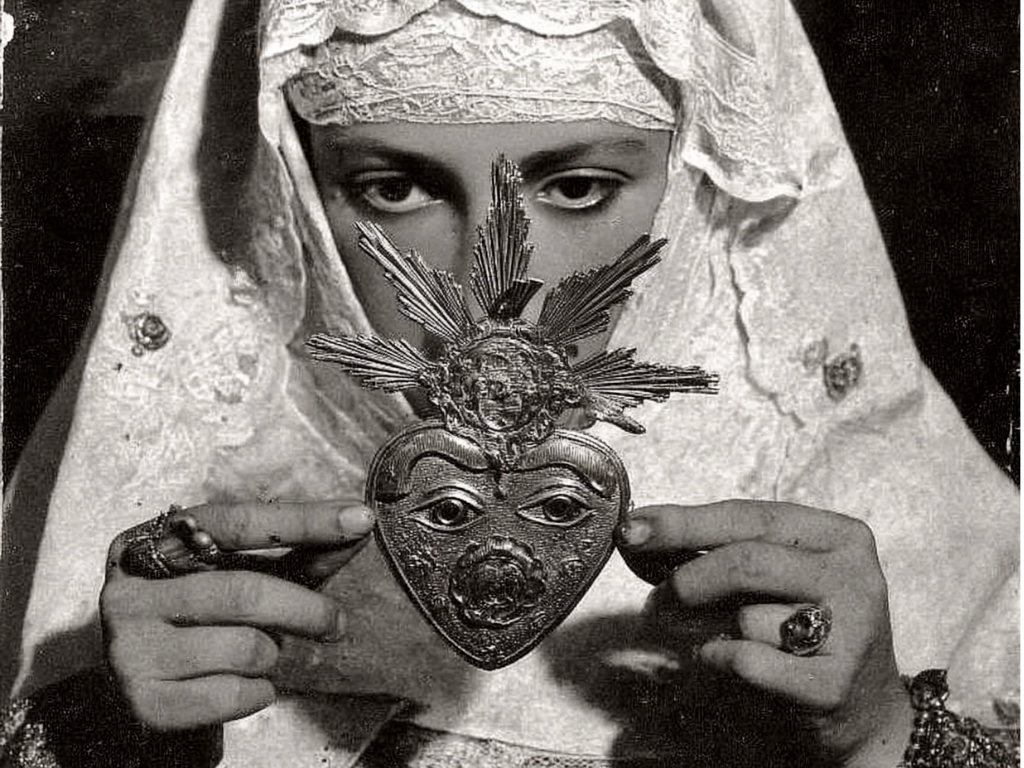
In your works, the boundary between human and machine feels porous. Is there, instead, something you still consider irreducibly human?
Images generate emotions, sensations, and haptic experiences. The visual isn’t separate from the affective and the multisensory. Every time I choose an image, I choose it always on the condition that it activates some personal memory or dream, that it transmits sensations to me. That part — reception — will always be human, and there intentions and affects intervene that bind you to the image. On the other hand, the things we speak of, what we select from reality, the emotions or memories or dreams of the past, all shape what we decide to create or select. That part is always human. Without a past, without specific tastes, without memories, without affects, a particular curation would be impossible. Each person is
free to create out of all this.
You have stated elsewhere that tenderness is a form of resistance. In what way do you interpret it as a political act?
Tenderness seems to me a form of resistance precisely because we live immersed in an imaginary that wants us a certain way — as closed, self-sufficient individuals, measuring ourselves against one another. It’s an imaginary that lives in the design of cities, in the rhythms of work, in the hurry, in that deeply rooted idea that to be worth something is to be self-sufficient. Ángeles Eraña says it in a way that moves me: the person is a corporeal resonance, existing only within the fabric of relationships that sustains it; the world weaves persons. And yet the order we live in needs to convince us of the opposite, it needs that isolated self. So tenderness, which is exactly the opposite of arrogance — that disposition that shuts the other out — becomes a gesture that disarms. To recognize the other in their fullness, to lean toward them, to expose oneself: that is already political, because it breaks the logic that wants us separated. Finzi Pasca’s theatre of the caress understands this perfectly: instead of striking the spectator, of confronting them — which is how almost everything around us operates — it chooses to caress them, to touch them with the lightness of the clown, to hold them. And that opens another time. There, tenderness does the same thing as the dream: it returns us to another logic, it reminds us that shared fragility, far from being weakness, is the place from which we can resist together, imagine other ways of inhabiting. To care for someone, to lean toward someone, in a world designed to make us indifferent, is already a way of proposing another form of life.
You have also said that “Mexico is inherently surrealist.” What do you think European realism fails to understand about the Latin American imaginary?
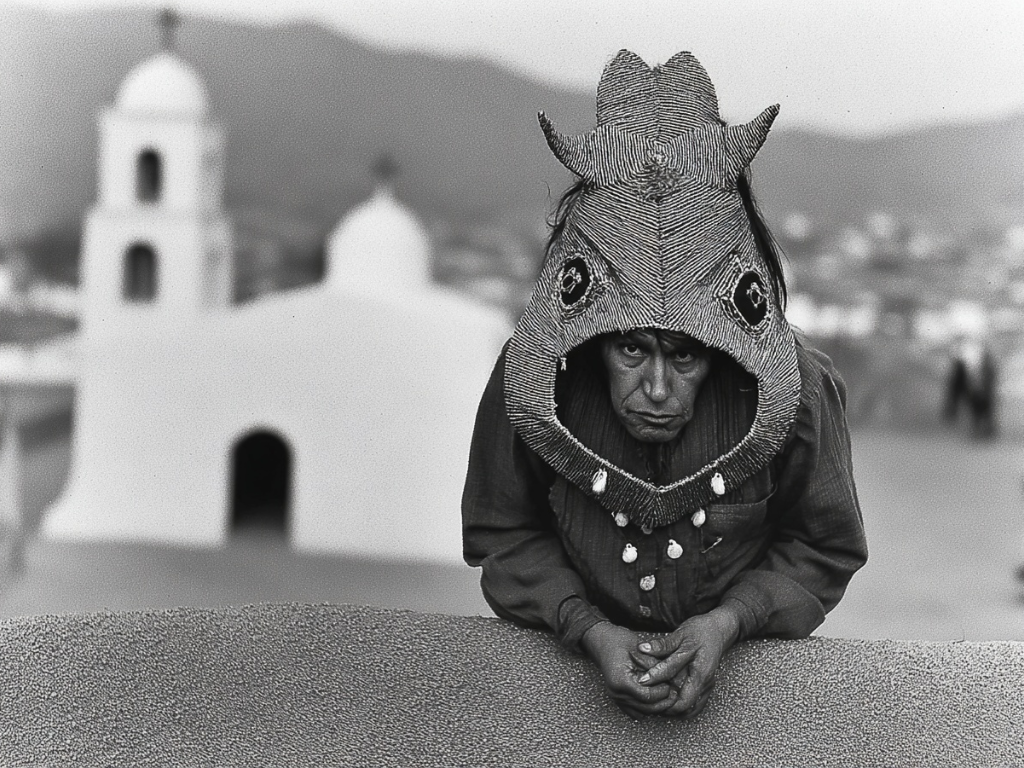
I would say that European realism inherited an already disenchanted world, where the real is whatever can be measured, and everything else is filed away under “imagination,” understood as the merely interior, the unreal. Its great achievement was also its blind spot: it learned to see the world by emptying it of the worlds that dwell within it. The Latin American imaginary never made that cut. Here the mythical is a way of inhabiting reality. When I say Mexico is surrealist by nature, I don’t mean the strange or the oneiric in the sense of the European avant-garde. Carpentier saw it clearly: what in Europe was a deliberate technique is, here, a condition of the real itself. The marvelous real. We live with one foot in the present
and the other in the mythical, and the two, far from canceling each other, sustain each other. There are people in Oaxaca who remain in conversation with the mountains, Huichol who travel through their dreams.
In your artistic universe, shamanism, cinema, philosophy, and AI coexist. Do you feel closer to an ancient tradition or to something radically future-oriented?
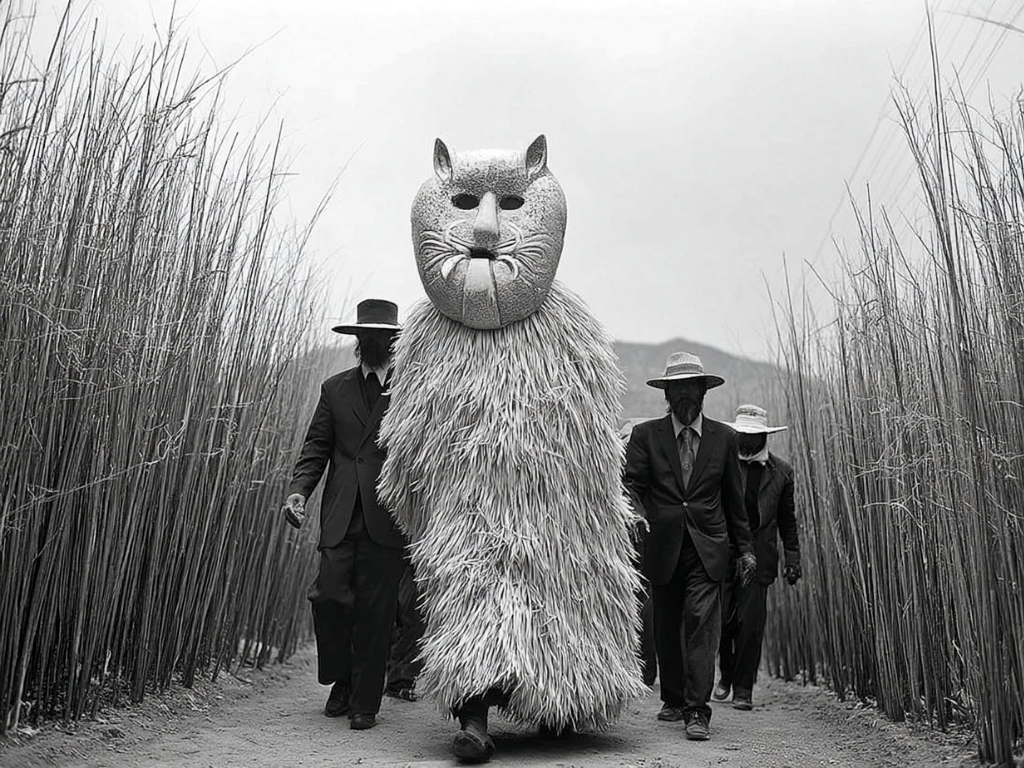
I don’t feel closer to one or the other. The question assumes that the ancestral and the radically future stand at opposite ends of a single line, and to me they seem to be the same gesture. The shaman who enters a trance to travel to other worlds, the cinema that sits us in the dark to dream awake, and now AI — the three are technologies of the imaginary. Ways of opening a door toward another reality, of making the invisible visible. The instrument changes, but the impulse is ancient. I see AI as one more transformation of artistic language, just as photography, cinema, and video were in their time: each one frightened those who believed art was being lost, and each one ended up being a new way of dreaming. AI is that for me — an oneiric, almost shamanic tool for inhabiting other imaginaries.
In conclusion, what would you like a person to carry with them after passing through one of your worlds?
I would like them to carry away a sensation rather than an idea. To leave with the certainty, even if only for an instant, that reality is more malleable than they believed. That the world we take as fixed is only one among many possible ones, and that within each person there is a door toward the others. If someone passes through one of my worlds and returns to their life with their imagination a little more awake, with that sense of agency recovered, of being able to dream and therefore to create, then we’ve already done something together. May they
leave with an image that stays stuck to the body and returns later, in waking life, the way a dream returns. And above all I would like them to carry away the beautiful suspicion that the invisible exists, that the mythical hasn’t been left behind but walks beside us, and that imagining other ways of inhabiting the world — more sensitive, more tender, more free — isn’t fleeing from reality, but the deepest way of inhabiting it.