Gardner Mounce, or Photography as Drift

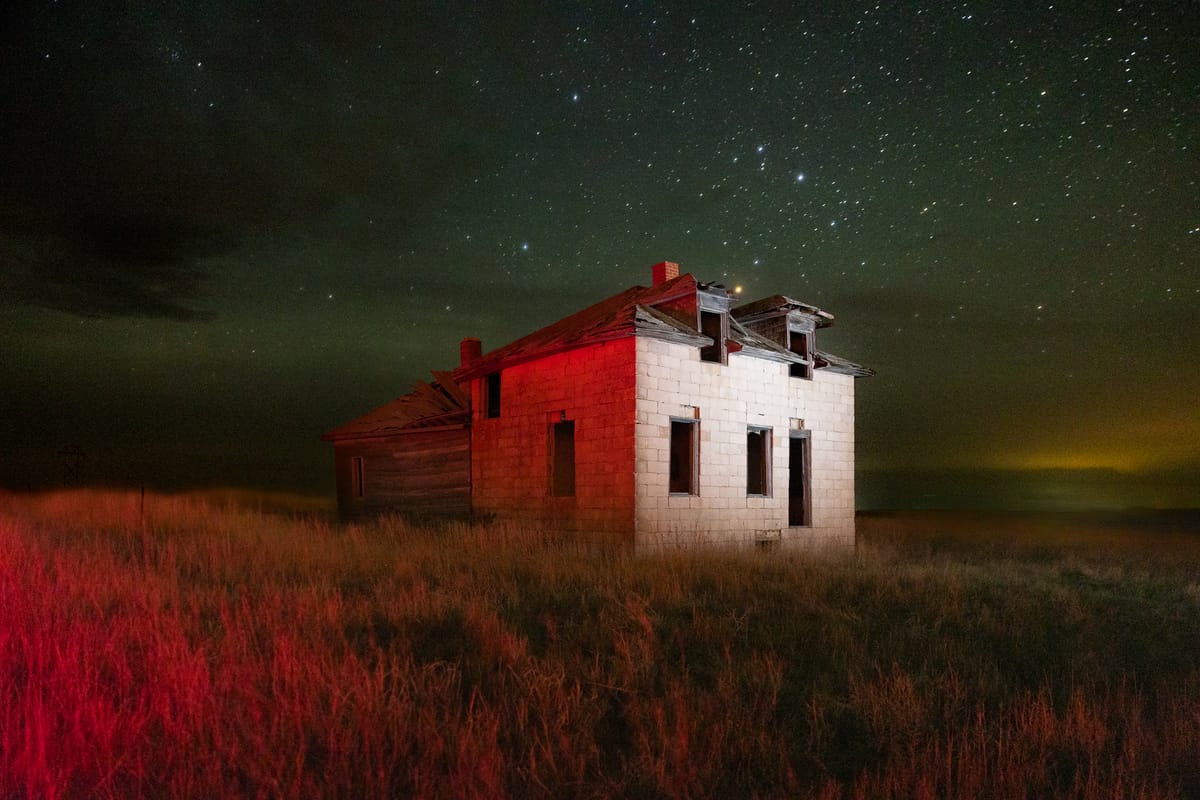
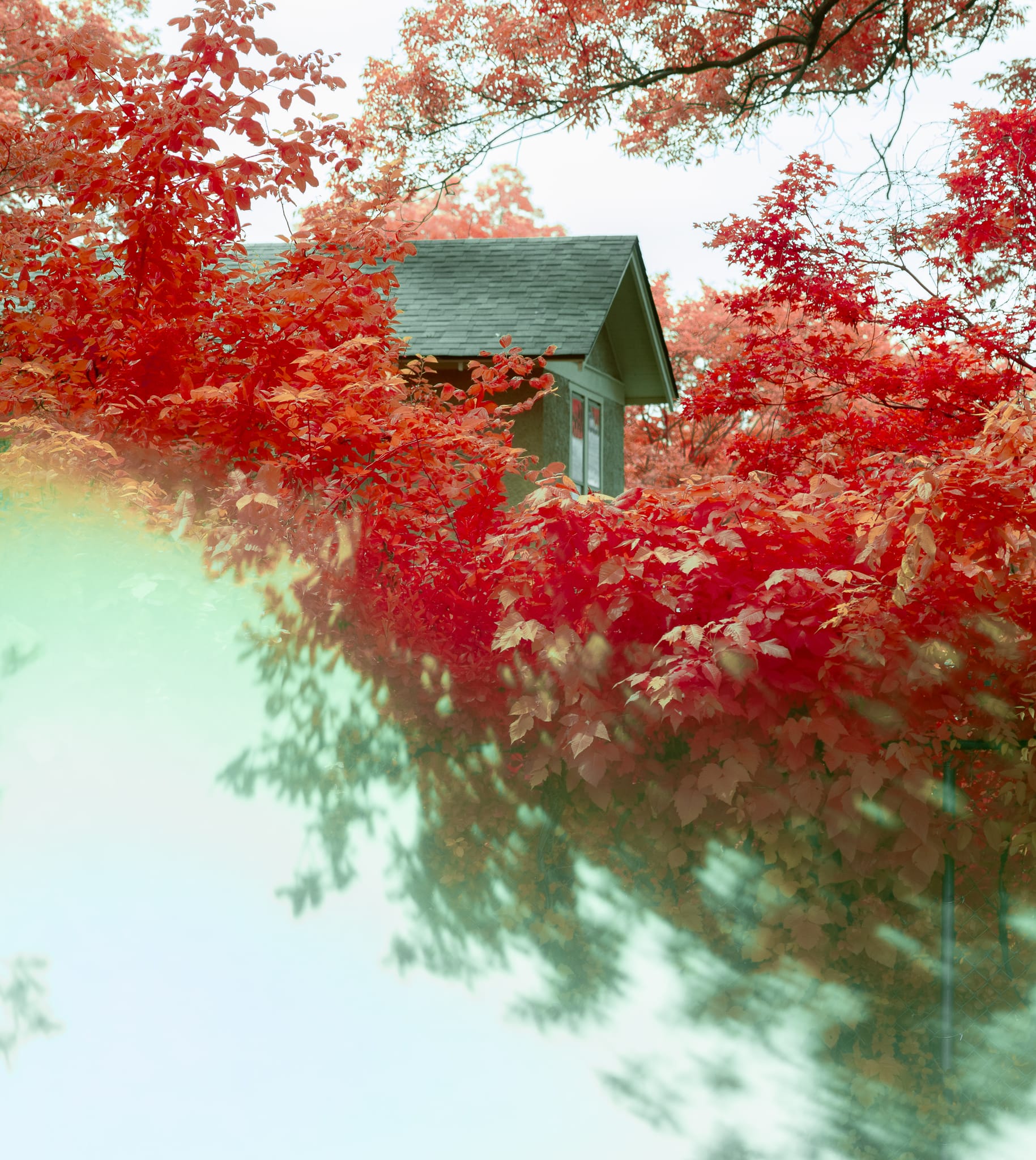
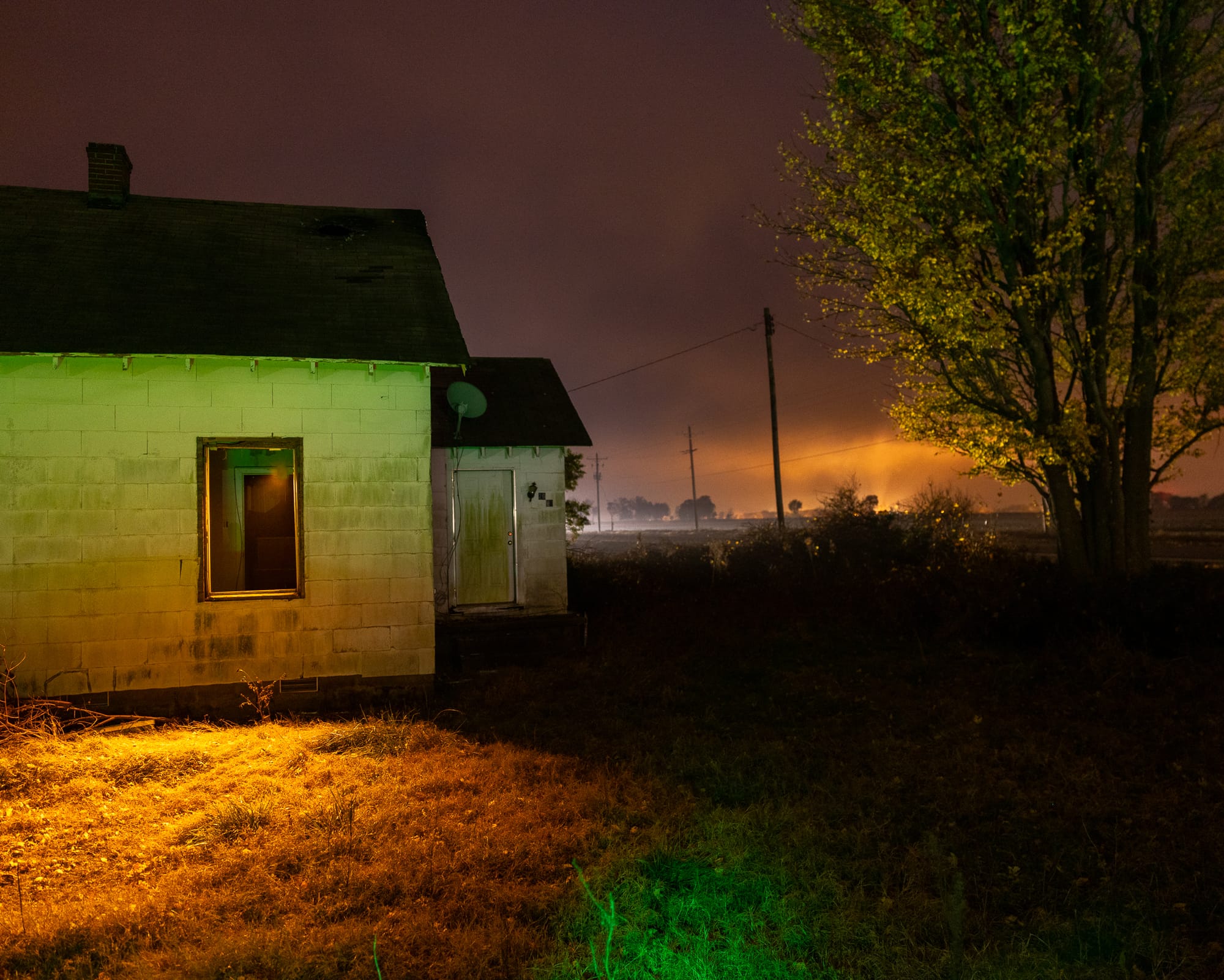
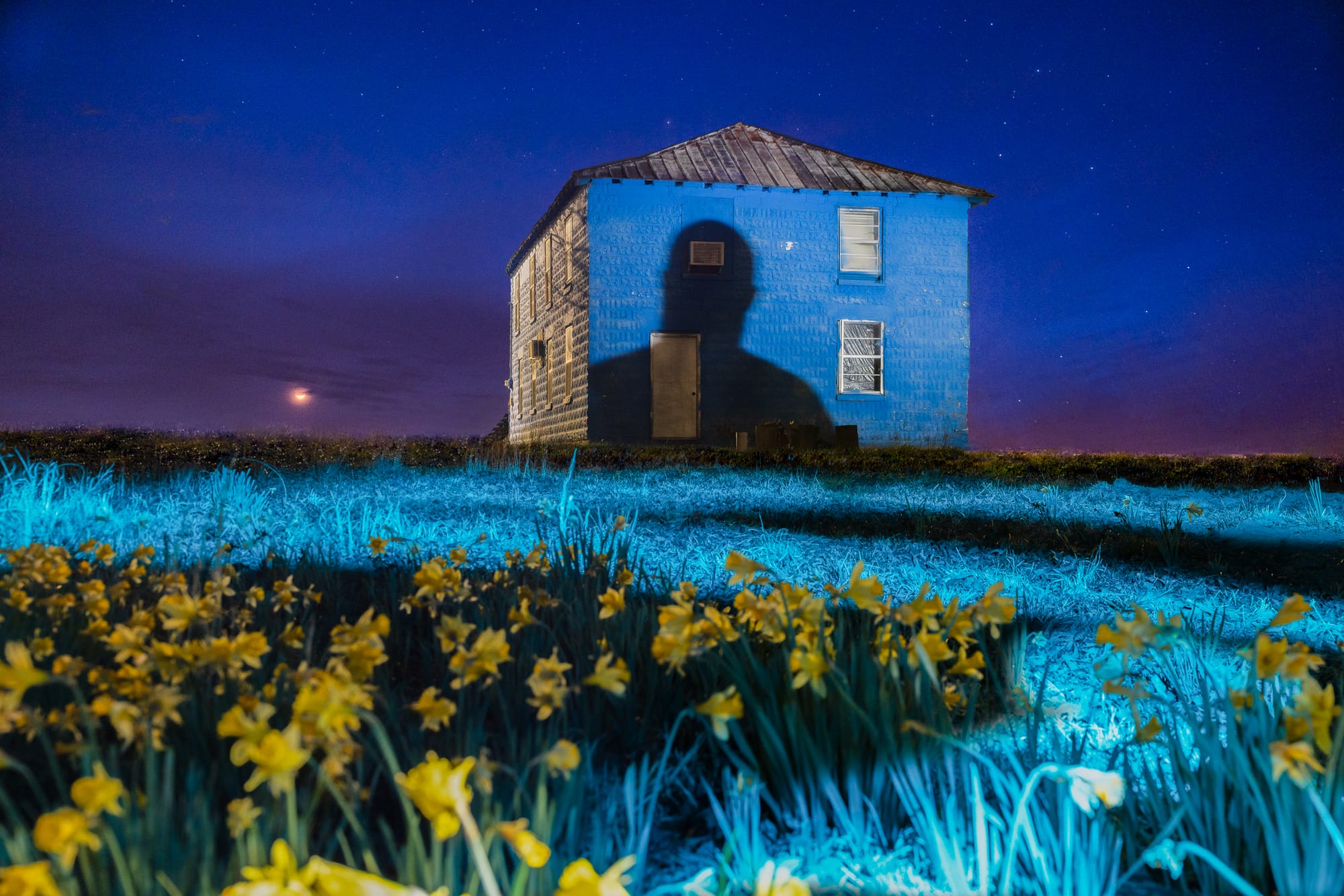
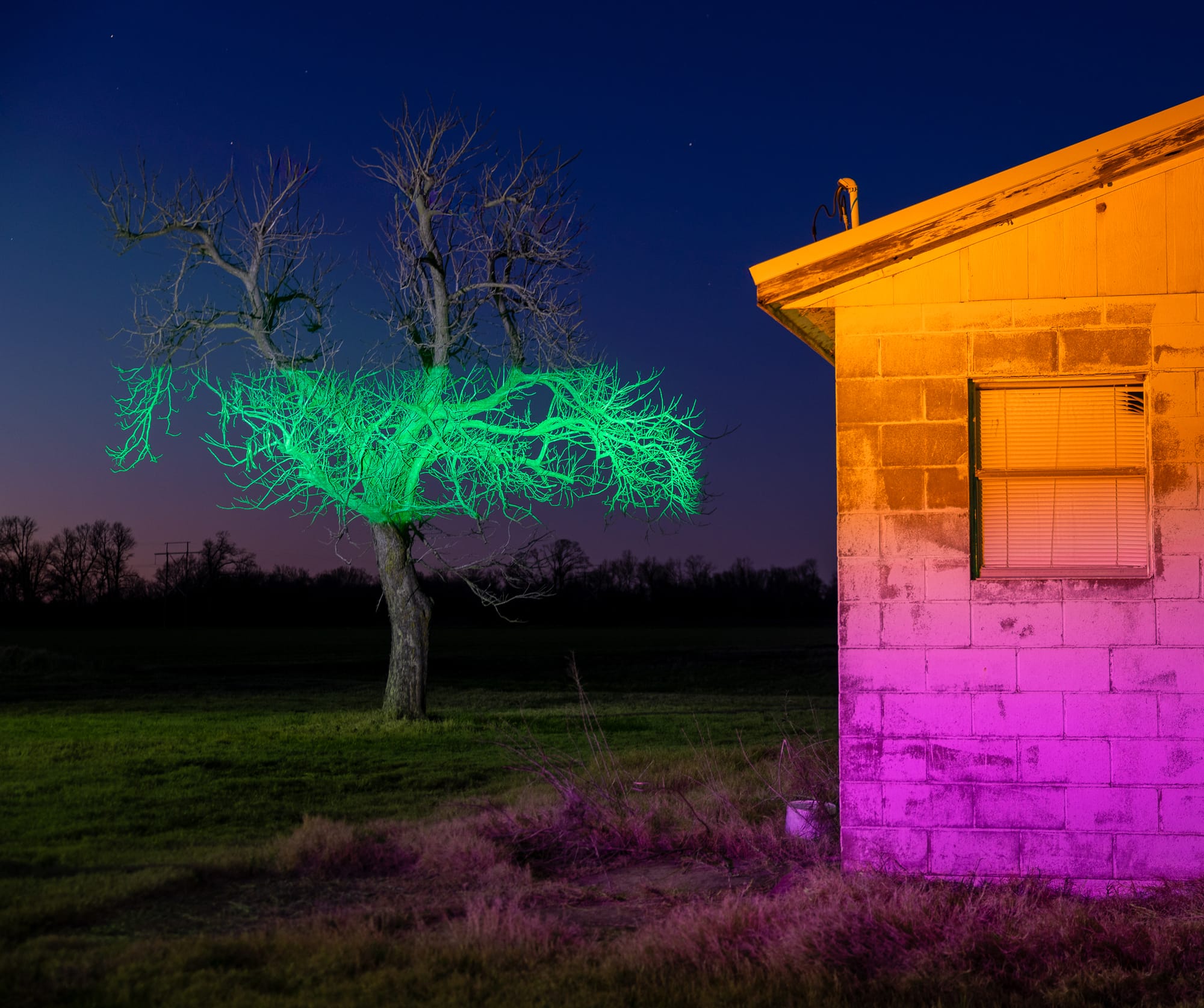
Gardner Mounce works as if his photography were a controlled accident: lasers slicing through space, UV light revealing odd colors, flashes casting sinister shadows; reality is documented, but its perception is distorted. He is self-taught in photography, but has also moved through the academic world of writing. He lives in Memphis, but his landscapes belong to a broader geography—an American periphery made up of Arkansas, Mississippi, Tennessee, California, and Colorado: rural zones, flatlands, abandoned places suffused by a stillness that’s never wholly peaceful. Places that seem on the verge of disappearing into thin air. In 2020, the pandemic arrived, he returned to his home city, and contracted a chronic illness that for years forced him into immobility: a rupture that emptied his life out and turned his days into a kind of aimless waiting. Today, Gardner works as a creative lead at an audio company in the Bay Area, while building a visual archive that seems to remain perpetually on the edges of stability. We exchanged a few words with him about his work:
You stated that, during your illness, your sense of identity gradually dissolved. Today, do you feel that this "lost self" has returned, or that photography has helped you construct a new identity?
My illness forced me to slow down and detach from the things I thought made me who I was. I couldn't travel, see friends, play music, take photos, write, or do much of anything. On good days, I could watch movies or listen to music, but there were lots of days that all I could do was lie in bed. That led, predictably, to an identity crisis. Who was I when I couldn't do the things I loved? When you're lying in bed day after day, unable to be productive or pursue any of your interests, what are you? I began meditating as a way of lowering my cortisol levels, and eventually I got into Buddhist philosophy, which I won't get too deep into because nobody wants to hear a white American guy explain Buddhism. But one idea that stuck with me is the concept of non-self: the idea that there is no fixed or inherent self. When you really get down to it, there's no such thing as being a photographer. I take photos less than one percent of the time. How can that possibly define what I am? These labels, like photographer, are a useful conversational shorthand to describe somebody’s interests, but they’re harmful when attached to too deeply. I've come to think that freedom and happiness don't come from discovering your identity and expressing it perfectly. They come from letting go of the idea that you have an inherent identity in the first place. Sometimes I take photographs, but I don't consider myself a photographer. Photography isn't a part of me, and my photographs aren't extensions of me. They're things I made, and now they're out in the world, separate from me. If you talk to me in person, I'm goofy and pretty dumb. In conversation, I have nothing in common with my photos. They pretty much have nothing to do with me.
You have described eastern Arkansas as a place that initially seemed desolate to you, but that you now consider extraordinary. What changed: the landscape itself, or the way you see it?
I'm definitely the one who changed. Living with a chronic illness that's largely misunderstood by both the public and much of the medical community gave me firsthand experience with neglect and abandonment—two qualities epitomized by the Eastern Arkansas landscape. I find myself drawn to places that feel vast and empty. When I was younger, those landscapes made me sad. Now I see something beautiful in them. I genuinely mean it when I say that I find western Kansas as beautiful as Hawaii. Kansas is spiritual, man.
In your work, the American South never appears folkloric or nostalgic. What is your relationship with the visual tradition of Southern Gothic?
You're right that I don't bring nostalgia to the American South! That reeks of MAGA to me. I also don't feel that Southern folklore is really mine to interpret as a white Southerner. When it comes to the history, politics, and cultural story of the South, Black voices are central. What I'm interested in is less the South as a cultural identity and more the visual and emotional landscape of Middle America. My work is concerned with the dreamlike and nightmarish qualities of these places. The beauty and unease that can exist side by side. Honestly, I probably think of myself more as a Great Plains photographer than a Southern photographer. The Southern landscapes that draw me most strongly are the ones that resemble the Plains: the Mississippi Delta, for example, with its immense flatness. There are certainly points of overlap with Southern Gothic, and some of those themes appear in my work, but I don't think those ideas belong exclusively to the Southeast. What resonates with me is a broader Middle American experience of abandonment, neglect, and decline. These places are deeply unsettling. The land was transformed through displacement and extraction in the service of westward expansion, only to be abandoned later or reduced to Arby’s and parking lots. It’s a nightmare, and it should make you angry.
You use lasers, UV lights, colored gels, flashlights, and long exposures. Do you consider yourself closer to the photographic tradition, or to a form of private performance that leaves a photograph as its trace?
I don't consider myself a photographer, nor do I feel connected to the photographic tradition. I don't deify photography or photographers, and to be honest, I don’t look at much photography. It’s a weird thing to admit, and I’m sure it sounds obnoxious, but I actually think my lack of investment in photography is one of the things that allows me to be good at it. When I was younger, I wanted desperately to be a writer. I cared so much about writing, admired writers so intensely, and took the craft so seriously that I eventually became incapable of doing it. The weight of my expectations crushed the ability to create. Photography has been the opposite. I enjoy making photos, but I don't place photography on a pedestal. I don't spend much time thinking about the medium itself or worrying about my place within its history. That distance gives me a freedom I never had as a writer. If I could wave a magic wand and become the writer I imagined I'd be when I was younger, I'd probably do it, but working in a medium that I don't feel possessive about has been surprisingly liberating. My ego isn't wrapped up in it.
You said that at a certain point “ambiguity and hidden meanings” in narrative began to stress you out. Yet your images are deeply enigmatic. Why has ambiguity become more tolerable in photography than in writing?
I think what I began to tire of was narrative itself. After my MFA in fiction writing, I realized that I'm a good writer, but I'm not much of a storyteller. I can write a great sentence, but I don't have stories inside me the way natural-born storytellers do. Writing a story always felt like building LEGO with oven mitts on. With enough time and dedication, I could do it, but geez was it frustrating. In my photography, I’ve leaned away from telling stories and into making something immediate and evocative. Making a good photo is kind of like setting up a really good opening paragraph of a story. You combine the right elements in the right way to hook somebody, but, unlike a story, that’s all you need. You hook them and you’re done. It’s so easy!
If someone were to see your work without knowing anything about your personal story, what emotion would you hope they carry with them?
I like when people say my work is spooky or unnerving. I worry that sometimes my work is too pretty or easy. I never want to make hotel room art. A good friend of mine said that he had a lot of trouble deciding which piece of mine to buy for his apartment because most of them scare him. Massive compliment.